Ion Straightening & Japanese Straight Perm in Hong Kong — Permanent Smoothing Treatment
Professional ion straightening (Japanese straight perm) at DT HUB Kwun Tong permanently restructures curly or frizzy hair into sleek, smooth, straight hair. From $1,580. English communication available.
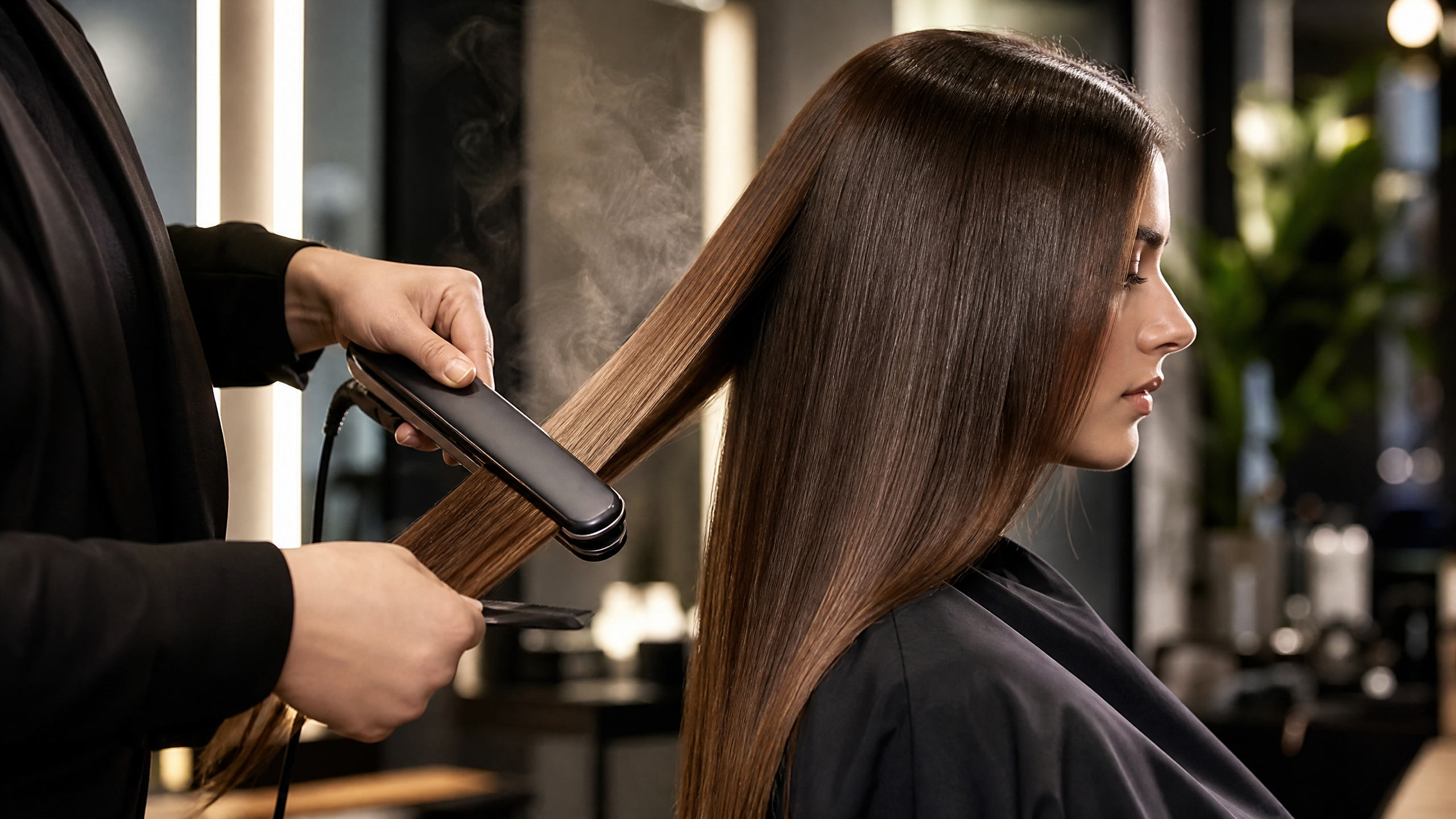
Ion straightening (Japanese straight perm) at DT HUB Kwun Tong (from HK$1,580) permanently restructures the hair's internal bonds to convert curly, wavy, or frizzy hair into smooth, straight hair. Results last until new hair grows in (6–12 months between touch-ups). Our technique preserves hair health with bond protection and customised formulations. English communication available.
For those with naturally curly, wavy, or frizzy hair who desire permanently straight, smooth locks, ion straightening (also known as Japanese straight perm or thermal reconditioning) offers a transformative solution. Unlike temporary straightening with flat irons that reverts with humidity or washing, ion straightening permanently alters the hair's internal structure — the treated hair remains straight until it is cut off.
At DT HUB in Kwun Tong, we have performed thousands of straightening treatments on diverse Asian hair types. We understand that not all curly or frizzy hair is the same: some clients have tight coils, others have loose waves with frizz; some have fine, fragile hair, others have thick, resistant strands. Our approach is never one-size-fits-all — we customise the formulation strength, processing time, and technique to your specific hair type and condition.
This guide explains how ion straightening works, who it is suitable for, what the process involves, how to maintain results, and what to realistically expect. We believe in informed consent — you should understand exactly what is happening to your hair before committing to a permanent chemical service. English communication is available throughout your consultation and appointment.
How Ion Straightening Works
Chemical solution breaks disulphide bonds (which create curl), hair is flat-ironed into straight position, then neutraliser reforms bonds in the new straight configuration. The change is permanent.
Hair shape — whether straight, wavy, or curly — is determined by the arrangement of disulphide bonds within the hair cortex. These are strong chemical bonds between sulphur atoms in adjacent keratin protein chains. In curly hair, these bonds are arranged asymmetrically, pulling the hair shaft into curves. Ion straightening works by chemically breaking these bonds, physically repositioning the hair into a straight configuration, and then reforming the bonds in their new position.
The process uses a reducing agent (typically thioglycolate or cysteamine-based) to break the disulphide bonds. Once broken, the hair becomes malleable and can be reshaped. The stylist then uses a flat iron at controlled temperature to physically straighten each section, aligning the protein chains in a parallel configuration. Finally, a neutralising (oxidising) agent is applied to reform the disulphide bonds in their new straight arrangement, locking the shape permanently.
The result is genuinely permanent — the treated hair will remain straight regardless of washing, humidity, or styling. However, new growth from the roots will emerge in your natural texture, creating a contrast over time that requires touch-up treatments every 6–12 months (depending on how quickly your hair grows and how much contrast you can tolerate between straight lengths and natural roots).
Who Is Ion Straightening Suitable For?
Suitable for naturally curly, wavy, or frizzy hair that is in good condition. Not recommended for heavily bleached, severely damaged, or very fine/fragile hair.
Ion straightening works best on hair that is in reasonably good condition — it is a chemical process that requires the hair to have enough structural integrity to withstand the treatment. Ideal candidates have naturally curly, wavy, or frizzy hair that they consistently straighten with heat tools (the treatment eliminates this daily damage), thick or medium-density hair with good elasticity, and hair that has not been heavily bleached or chemically processed.
We do not recommend ion straightening for: hair that has been bleached more than 2 levels (the structural damage from bleaching combined with straightening chemicals can cause breakage), very fine or fragile hair (which may not withstand the chemical process), hair with significant existing damage (breakage, extreme dryness, elasticity loss), or clients who want to maintain the option of curly styling (the change is permanent and cannot be reversed).
During your consultation, we assess your hair's condition using elasticity tests, porosity checks, and visual examination. If your hair is not suitable for full ion straightening, we may recommend alternatives: keratin smoothing treatment (temporary, less aggressive), or a partial straightening that relaxes curl without making hair pin-straight. We always prioritise hair health over achieving a result.
| Hair Condition | Suitability | Recommendation |
|---|---|---|
| Virgin curly/wavy hair | Excellent | Full ion straightening |
| Previously coloured (no bleach) | Good | Standard formulation with bond protection |
| Lightly bleached (1–2 levels) | Moderate | Gentle formulation, careful monitoring |
| Heavily bleached (3+ levels) | Not suitable | Keratin smoothing instead |
| Very fine/fragile | Caution | Gentle formulation or keratin alternative |
| Severely damaged | Not suitable | Repair treatments first, reassess later |
The Treatment Process
Consultation → wash → softening solution → rinse → blow-dry → flat-iron straightening → neutraliser → rinse → conditioning → style. Total: 3–5 hours.
Ion straightening is a lengthy process — expect to be in the salon for 3–5 hours depending on your hair length and thickness. The process begins with a thorough wash using a clarifying shampoo to remove any product buildup that could interfere with chemical penetration. Your stylist then sections your hair and applies the softening (reducing) solution, carefully avoiding the scalp.
Processing time varies from 15–45 minutes depending on your hair's resistance and the formulation strength used. Your stylist monitors the hair throughout, performing strand tests to check when the bonds have sufficiently softened. Once ready, the solution is rinsed out thoroughly and the hair is blow-dried straight. Then comes the most critical step: flat-ironing each section at controlled temperature (typically 180°C) to physically align the hair in its new straight position.
After flat-ironing, the neutraliser is applied to reform the bonds in their new configuration. This processes for 10–15 minutes, then is rinsed out. Finally, a deep conditioning treatment is applied to restore moisture and seal the cuticle. Your stylist finishes with a gentle blow-dry and style. For the next 48–72 hours, you must avoid washing, tying, or tucking your hair behind your ears to allow the bonds to fully stabilise.
Aftercare and Maintenance
No washing for 48–72 hours post-treatment. Then: sulphate-free shampoo, regular conditioning, avoid chlorine, touch-up roots every 6–12 months.
The first 72 hours after ion straightening are critical. During this period, the reformed bonds are still stabilising, and any bending, crimping, or wetting can create permanent dents or waves in the hair. Do not wash your hair, do not tie it up, do not tuck it behind your ears, and do not use clips or pins. Sleep with your hair loose and straight. If it rains, protect your hair with an umbrella.
After the initial 72 hours, you can resume normal washing and styling. We recommend sulphate-free shampoo (sulphates can gradually weaken the reformed bonds), regular deep conditioning to maintain moisture, and heat protection if you use styling tools. Avoid chlorinated swimming pools without a protective cap, as chlorine can damage chemically treated hair.
Touch-up treatments are needed every 6–12 months as new growth emerges in your natural texture. Touch-ups only process the new growth (typically 3–8cm), not the previously straightened lengths. This is faster and less damaging than the initial full-length treatment. Most clients settle into a routine of touch-ups every 8–10 months.
Frequently asked questions
How long does ion straightening last?
The treated hair remains permanently straight. However, new growth from roots will be your natural texture, requiring touch-ups every 6–12 months depending on growth rate and tolerance for contrast.
Can I colour my hair after straightening?
Yes, but wait at least 2 weeks after straightening before colouring. We recommend colouring first if you plan to do both, as colour-treated hair is slightly more fragile during the straightening process.
Will my hair look unnaturally straight?
We customise the result to your preference. Some clients want pin-straight hair; others prefer a natural-straight look with slight movement at the ends. We discuss your desired outcome during consultation.
Is it the same as keratin treatment?
No. Keratin treatments are temporary smoothing treatments that reduce frizz and add shine but do not permanently restructure the hair. They last 2–4 months and gradually wash out. Ion straightening is permanent.
Can I curl my straightened hair with tools?
Yes! Ion-straightened hair can be temporarily curled with curling irons or rollers. The curls will hold for the day but revert to straight after washing. This gives you versatility.
Is it painful or uncomfortable?
No. The process is not painful. Some clients notice a slight chemical smell during processing and warmth during flat-ironing, but there is no pain or discomfort.
What if I want to go back to curly?
Ion straightening is permanent and cannot be reversed chemically. The only way to return to your natural texture is to grow out the treated hair and cut off the straightened lengths over time.